
BUILDING PAST YOUR PERSONAL CAPACITY
When the Brand Is You
In founder-led brands, the company and the founder mirror each other.
Your vision, your taste, your way of seeing the world — they all shape your brand, they are the blueprint of its identity.
But your brand also reflects your energy, your pace and your state of mind. When you’re grounded, the business feels clear and intentional. But when you’re constantly overwhelmed, it becomes reactive and unpredictable.
That’s why real growth starts with alignment: between you and the business you’re building. Everything else follows.
My Story: What I Learned the Hard Way
I built my activewear brand, Daquïni, from the ground up and grew it into a globally stocked brand across 26 countries, sold worldwide online, worn by celebrities, and featured in the glossiest magazines and Hollywood movies.
I love vision. I love strategy and creation. I loved building the brand. It was my baby. I gave it my time, attention, and energy, sacrificing my personal wants and needs — a sacrifice that felt fulfilling because the work was deeply meaningful. I was growing alongside my business, which became the most important part of my life.
Until there was little else left.
Finding and pursuing our passion is often pictured as the ultimate source of fulfillment. But what’s rarely discussed is that the more meaningful the work feels, the easier it is to overextend — because it doesn’t feel like self-abandonment. It feels like devotion.
Yet passion without structure eventually turns into exhaustion.
Passion makes you willing to sacrifice. Structure is what decides how much. And if you build without it, you don't notice how far you've drifted from yourself until the business you loved starts to feel like a weight you're carrying rather than a life you're building.
The brand I built grew far beyond what I’d imagined. And I still felt empty when I got there. I'd built something that demanded everything from me — always on, always managing, always available. I was just trying to get through the day. And when I stopped growing, the business did too.
It took time to understand this wasn't failure. It was misalignment.
So What Does Alignment Actually Mean?
Alignment isn't about doing what simply feels good.
It's about coherence between your values, ambitions, nervous system, leadership style, capacity, and business model.
It means building a company that supports the life you want to live — not the image of success the industry handed you, stitched together from hustle culture, status symbols, and someone else's definition of what "making it" looks like.
Alignment keeps your success and well-being in sync. It's what makes growth sustainable.
Whether you're just starting or scaling, alignment is what you return to — the place where you reflect, refine, and realign with what really matters.
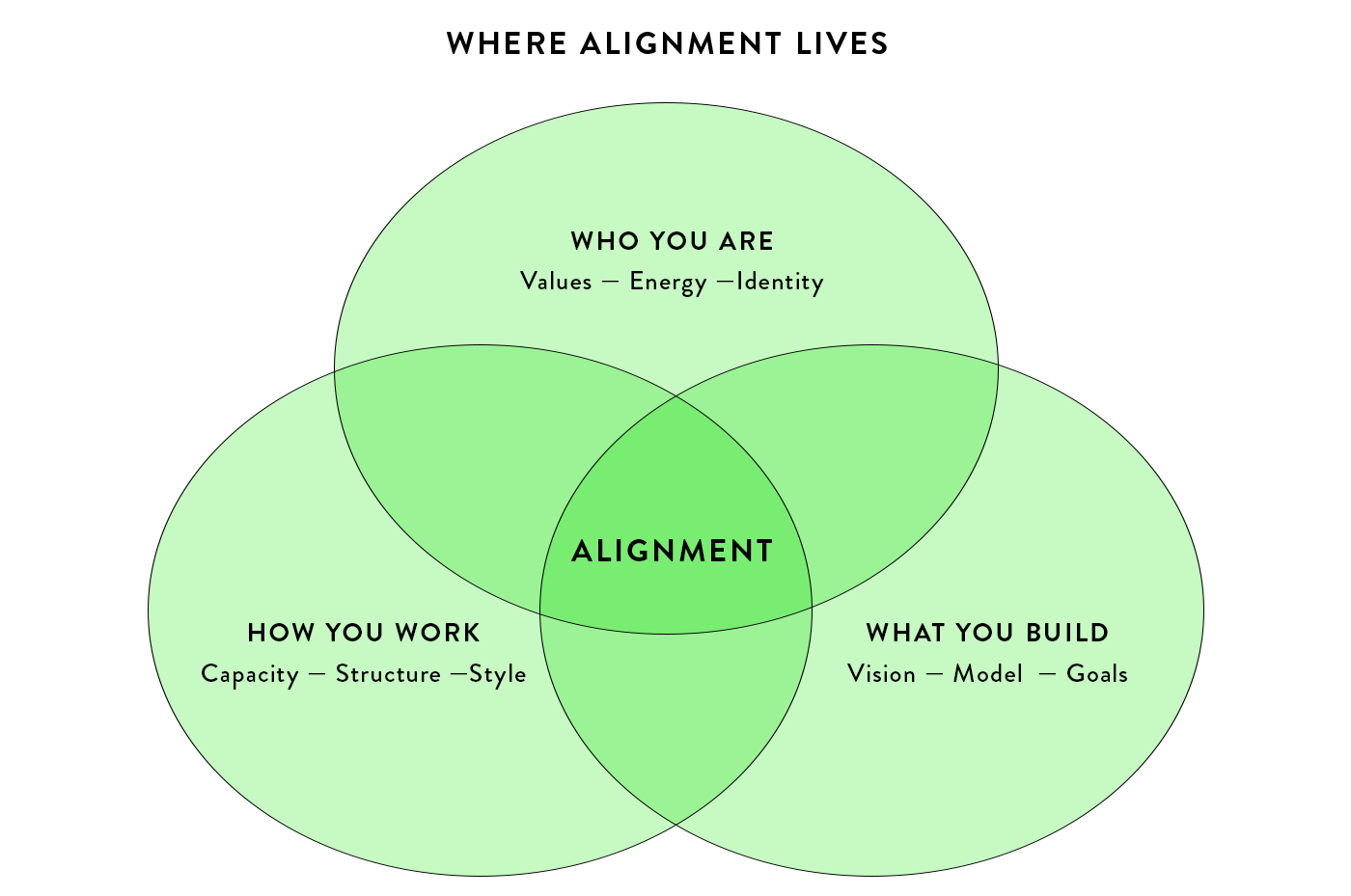
Alignment lives at the intersection of identity, capacity, and business model.
The Hidden Cost of Building Without It
When every decision, idea, and execution flows through you, growth becomes dependent on your capacity.
At some point, the business cannot expand without asking you to evolve beyond the version of yourself that built it. What got you here may be what holds you back from going further.
It requires letting go of control, leading differently, and stepping into a new role — and a new identity.
This is often when growth shifts from feeling exciting to threatening, especially in fashion, lifestyle, and wellness brands where the founder’s identity is deeply embedded in the brand.
When decisions are driven by fear, when you are constantly putting out fires, solving operational issues, answering every message, and approving every detail, growth turns into maintenance instead of expansion — slowly burning out not only your passion but you.
Founder burnout builds quietly, disguised as dedication.
This is where many founders get stuck — where the founder’s ceiling becomes the company’s ceiling.
Why Alignment Determines How You Scale
Most founders focus on building the business first, assuming it will get easier as it grows. But if the internal foundation is unclear, growth will only magnify that.
Alignment determines how you build and scale, what you delegate, what you tolerate, and who you become in the process.
It keeps you from building something that demands more than you can sustainably give.
Alignment Is Your North Star
Alignment doesn’t mean you have it all together all the time.
Some seasons are messy. You’ll be running on little sleep, skipping meals, missing moments with people you love. Building a business is demanding. That’s real.
The difference between those seasons being temporary and becoming your whole life is this: knowing your vision. The reason behind it all. When you’re grounded in that, you can find your way back, no matter how chaotic it gets.
The Work of Building a Life That Fits
Your business will surface your fears, question your confidence, and challenge what you believe you’re capable of and what you deserve. This is part of the journey.
Growing a business and growing as a person are not separate processes.
There will be versions of yourself you need to grow into — and older versions you need to let go of. Beliefs and patterns that once protected you may now be what stands between you and your next level.
There will be steps you’re not ready to take yet. And that’s okay. This isn’t a race to someone else’s finish line. It’s the work of building a life that fits your own version of success — your truest, most creative, most capable self. The one that feels most like you.
Your Next Step
If any part of this resonated, it's probably because you've already felt some version of it. That feeling is information. And it's a good place to start.
The Alignment Framework is the first free part of a modular system I'm building — a guided audit with reflection tools to help you create with clarity, lead with intention, and build a business that supports the life you want.
Take the 45-second quiz to join the waitlist and receive access when it’s ready.